
A Powerful Fear
The biggest fear, when you think about investing your money, while being on retirement, or mini-retirement, is the fear of loss.
Its a very powerful fear …. as this is the money you need for survival. Survival for the next year, survival for the next 3 years, survival for the next 5.
This is particularly acute for mini-retirement, or re-invention retirement. Here you need a laser focus on pivoting, on taking all you have built within your persona, and exposing it to the world. And you cant let the fear of money interfere with all that flow. The flow must happen.
How do you get over that fear ?
Barbell strategy
The barbell strategy is an idea, popularized in the literature by Naseem Nicholas Taleb. The idea is that you fundamentally change your portfolio mix. Instead of having a core market fund (which goes up and down with the market), you have two funds. A core fund that has very low volatility, and a ‘venture’ fund that has very high variability. Your low fund buffers the ongoing expenses and volatility. Your speculative fund gives you an upside exposure.
You expect to loose your speculative fund, year after year, after year !
Yes, you read that right.
But think about it….. If you loose 5% every year, but are saved from a 30% expected market meltdown, any week/day of the year, what will help you sleep better at night ?
A chance of loosing 30% of your savings, any time of the year, or a near certain chance of loosing 5%. Thats where you come to grips with the psychology. And this is particularly powerful, for mini retirement.
Here is what a rough distribution of outcomes for SPY the most commonly followed index of S&P500 companies, looks like:
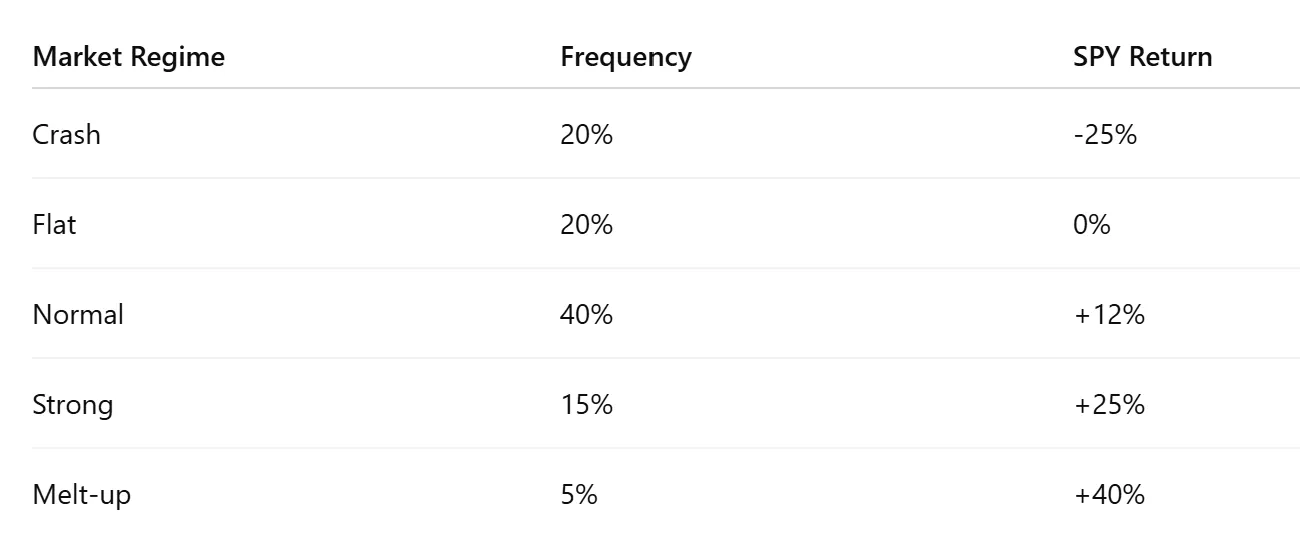
This approximately follows the historical distribution.
With an average return of ~10%.
A SPY Example
Now imagine starting your mini-retirement with a saved amount of 300K. Putting it in the market fund with an expectation of 10% return. Here is what the math looks like for the money.
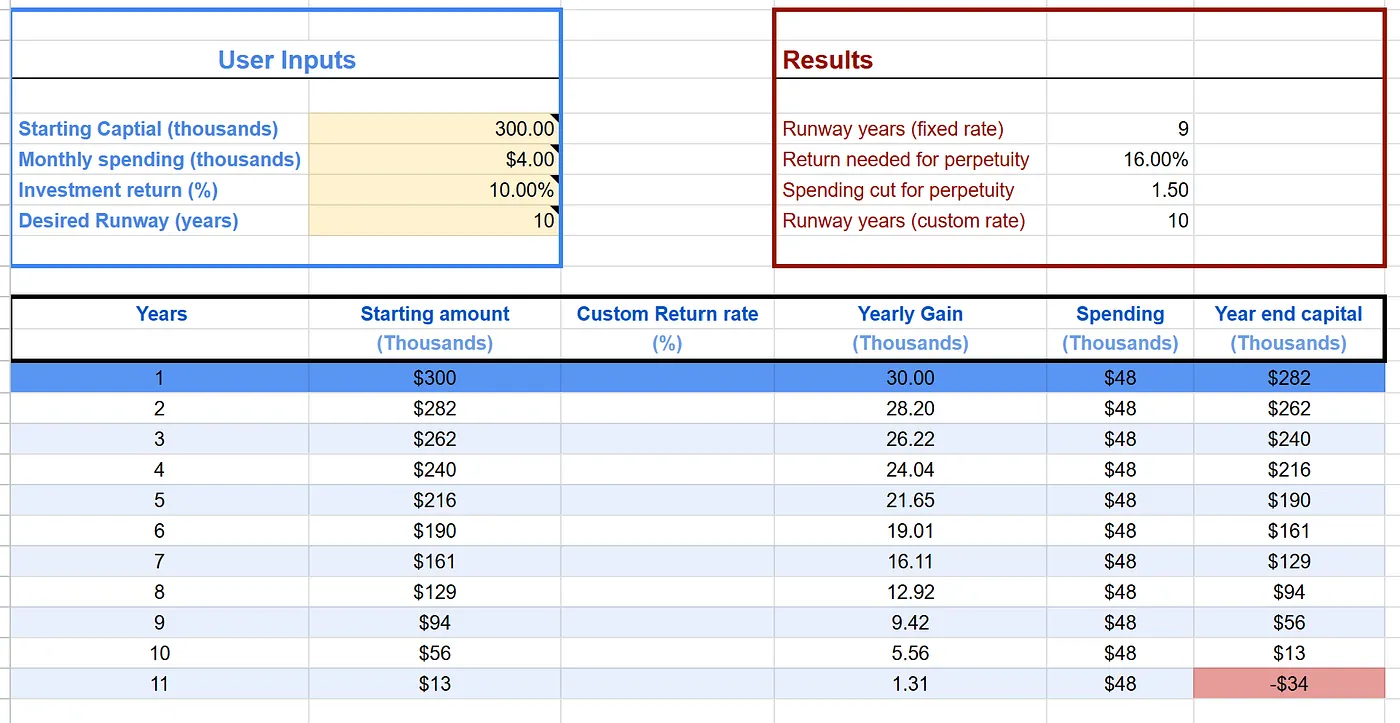
As you can see, this amount, with an even 10% return, lasts about 10 years (and a bit more).
Now imagine, hitting the crash year on the SPY (-25%) in your very first year of mini-retirement. Here is what it would look like.
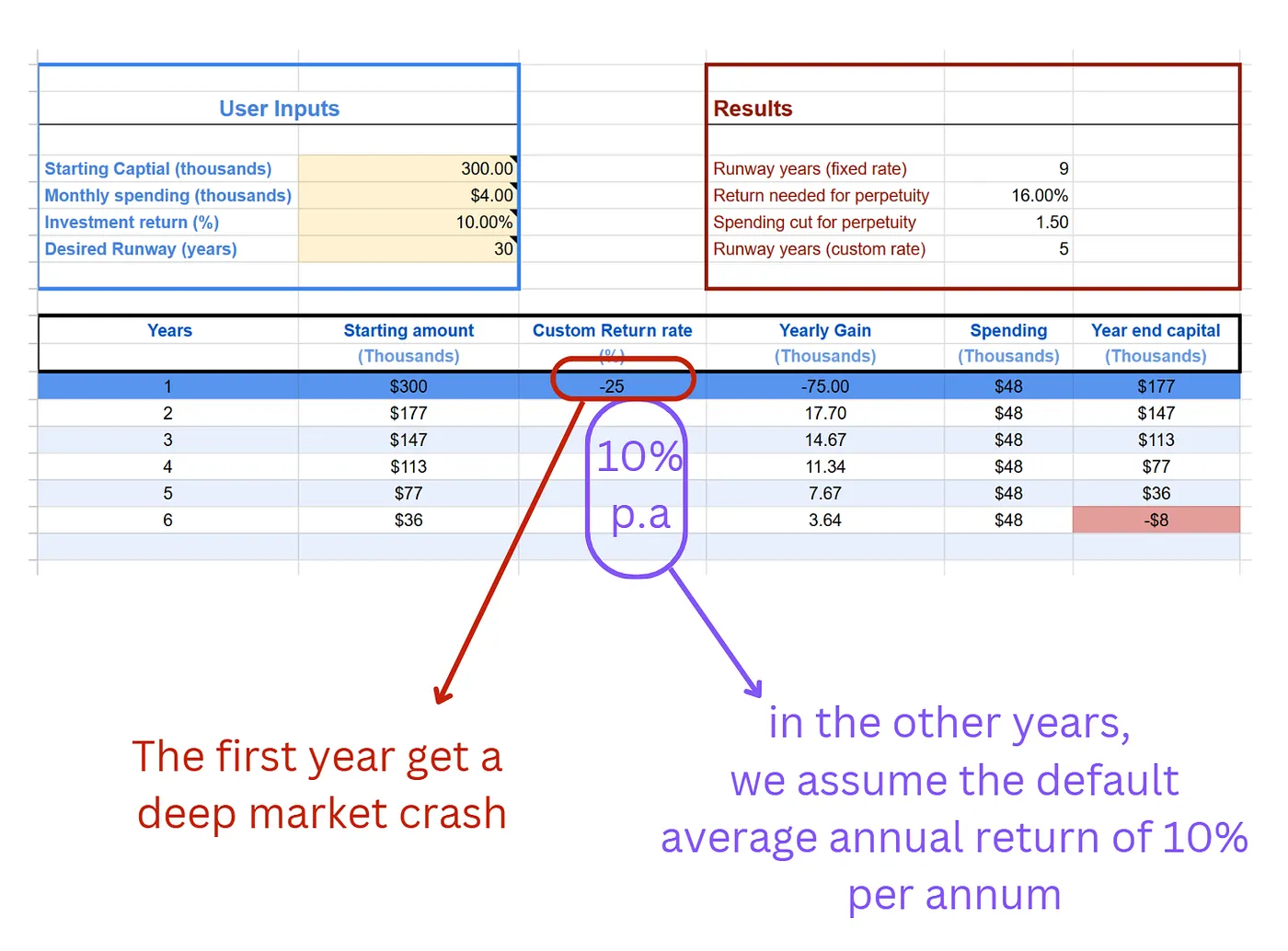
Notice how the crash has led to the retirement timeline cut from 10 years to 5 !!!
This is HUGE.
Now remember that the crash might recover the next year, like covid crash did.
But the psychology has been irreparably harmed.
The months and the year that you will live through the crash, with your funds now lasting only half as long, will be some of the toughest months ever.
All because you trusted your money to the market fund.
An Alternative way to think
Now imagine, an alternative way.
In this one, you put 95% of your money, in treasury bonds. Something that yields maybe 3–4% with nearly zero risk. (less than 1% of volatility).
You take the remaining 5% and invest it in a highly leveraged bet. Something like : “ if the market moves positively or stays the same, I make double of what I staked, and if the market goes down, I loose 100% of my bet”
You can implement this leveraged bet, by buying a ‘call option’ in the lingo of finance.
If you make a bet like that…..in the down year, you can loose the entire 5% stake. And in a normal up year, you can double your 5% stake, to have a yield of 5% on the speculative portion of the portfolio.
Here is what those results might look like
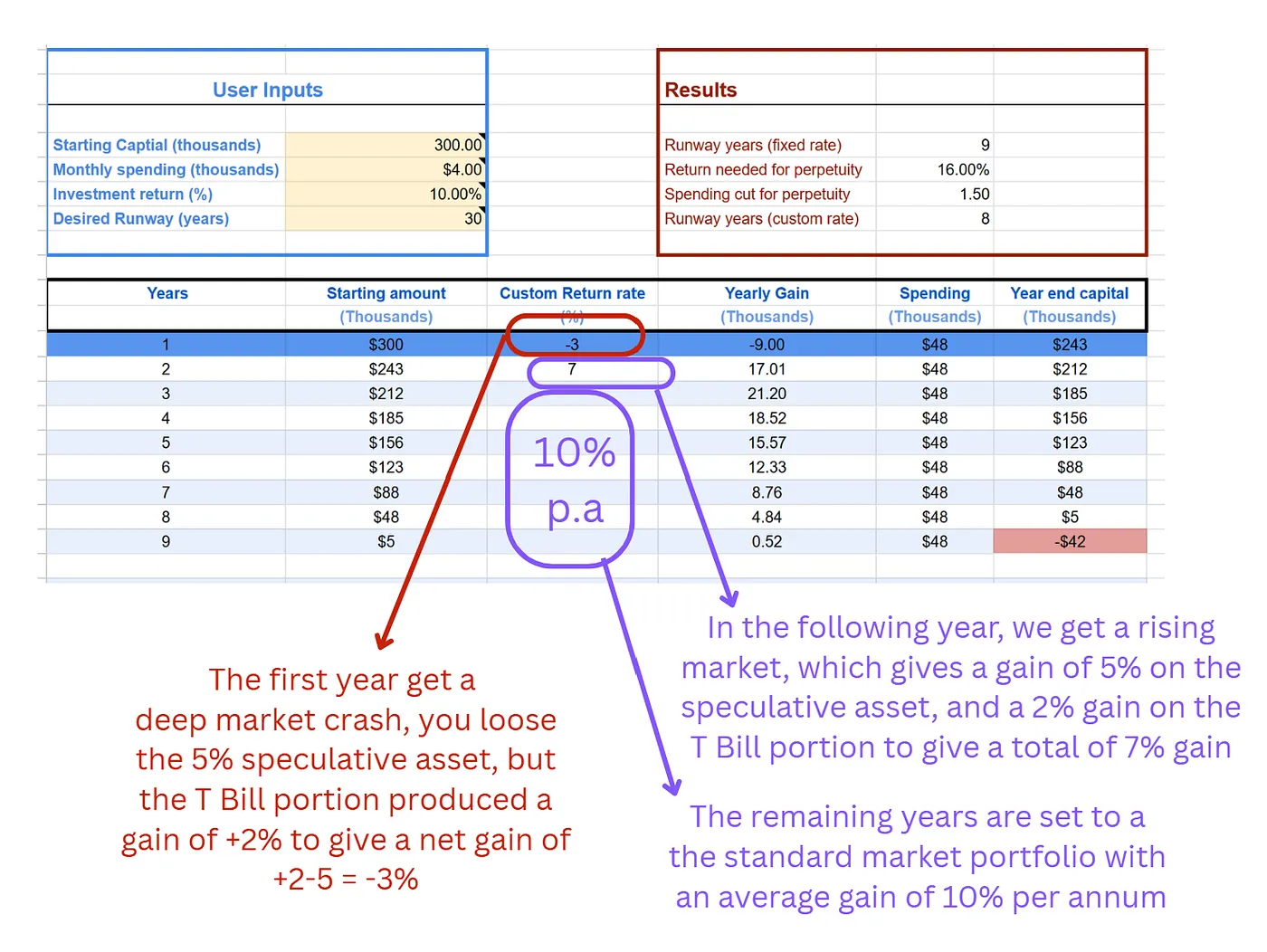
In the simulation above, we has a barbell portfolio for the first two year, one of which had the deep market crash. But since only 5% of the portfolio was speculative, we only lost about 3% in the crash. The second year was an up year. And the portfolio was shifted to a market portfolio for the remaining years, for easy comparison.
After the two years, we put the portfolio back into the market fund (with a 10% per annum average return), just to have an easier comparison. Here it is observed that the crash might still happen, but every year that the crash is delayed, from the start of retirement, the damage that it can cast weakens.
Notice how having the barbell portfolio for the first two years, have restored the mini-retirement time-line from 5 year, to 8 years. Thats a massive jump in the life expectancy of the portfolio. All because you dialed down the risk of the portfolio in the barbel fashion.
Conclusion
Barbelling is a very strong portfolio strategy. Especially when you are in the beginnig of your mini-retirement. In the beginning, the portfolio is sensitive to deep drawdowns. As the first few years pass, the impact of a deep draw down fades. So its imperative to put thought into portfolio construction for the first few years of mini-retirement. This article demonstrated how the early risk plays out on the life of the portfolio. And how an alternative arrangement can work wonders for the life of portfolio.